As global consumer demand for low-glycemic, reduced-calorie, and “zero-added-sugar” products accelerates, food product developers (R&D) and procurement teams face a core operational challenge: How to replace sucrose without sacrificing bulk, texture, Maillard browning, and clean mouthfeel.
While high-intensity sweeteners (such as Stevia and Monk Fruit) solve sweetness requirements, they lack the bulk and structural functionality of traditional carbohydrates. Polyols like Erythritol offer volume, but often cause gastrointestinal discomfort or impart an intense cooling effect in finished formulations.
Enter D-Allulose (D-psicose)—a natural rare monosaccharide and C-3 epimer of D-fructose. Delivering 70% of the sweetness of sucrose with a negligible caloric burden of 0.4 kcal/g (~10% of sucrose), Allulose has rapidly become the premier sugar substitute for commercial food and beverage manufacturing.
What Is D-Allulose as a Sugar Substitute?
D-Allulose is a rare monosaccharide structurally similar to D-fructose, with only a single hydroxyl group inverted at the C-3 position. Because the human body absorbs it in the small intestine (66.2%–80%) but cannot metabolize it for energy, it passes through and is excreted unchanged via urine and feces.
Unlike traditional sugars, it exerts minimal impact on blood glucose or insulin levels. In key markets like the United States, it is officially exempted from “Total Sugars” and “Added Sugars” on nutrition facts labels, allowing brands to feature clean “0g Added Sugar” claims on packaging.
Key Functional Properties for Formulators
What sets D-Allulose apart from other rare sugars and sugar alcohols is its unique balance of physical chemistry and sensory performance:
- Sweetness Profile: Delivers 70% of sucrose sweetness with a clean, sugar-like onset and zero lingering bitter aftertaste. Its sweetness intensity remains stable across fluctuating ambient temperatures.
- Solubility: Exhibits exceptional solubility—up to 291g / 100 g H₂O at 25℃ (74w/w), making it highly scalable in liquid syrup formulations and RTD beverages.
- Thermal & Acid Stability: Highly inert under processing conditions. In comparative hydrolysis testing (pH = 2.0 at 100℃ for 60 minutes), sucrose completely breaks down into glucose and fructose, whereas D-Allulose remains 100% stable without decomposition.
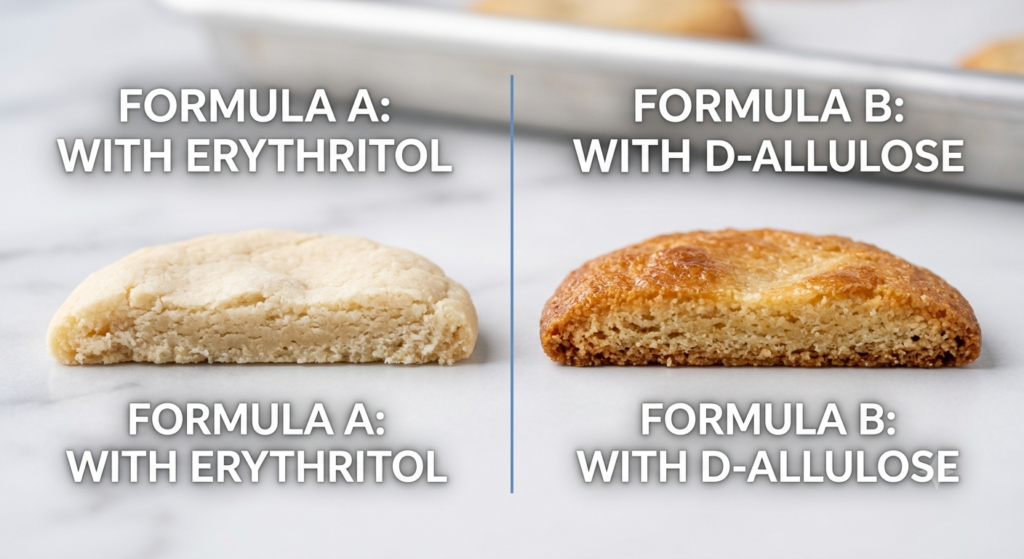
- Maillard Browning Activity: Features an active keto group that participates readily in Maillard reactions, providing natural browning and crust coloration in baked goods.
📌 From our supplier experience: A commercial bakery client recently tried substituting 100% of their sucrose with erythritol and stevia, only to find their cookies looked pale and lacked structural snap. When we introduced a balanced D-Allulose blend, the cookies achieved golden crust coloration and crisp snap within standard oven parameters. Always evaluate your browning requirements when shifting from polyols to allulose.
Sector-Specific Application Guidance
D-Allulose functions as a structural building block across multiple food and beverage categories:
- Bakery & Confectionery: Ideal for cookies, cakes, and breads. While yeast does not readily ferment allulose, replacing up to 25% of sucrose significantly improves crumb softness and moisture retention during shelf storage. In hard candy boiling (160℃–170℃), a 20%–25% allulose matrix yields crisp, non-sticky textures.
- Dairy & Frozen Desserts: Because allulose’s molecular weight (180.16 g/mol) is half that of sucrose (342.3g/mol), it depresses freezing points more aggressively. To prevent shrinkage in ice cream, combine 10%–18% D-Allulose with high-intensity sweeteners or bulk polyols to preserve scoopability.
- Beverages & Fermented Dairy: In yogurt processing, incorporating allulose (>70%DS) inhibits post-acidification by lactobacilli during cold storage, effectively extending shelf life. In protein and plant-based milks, an inclusion rate of 5%–8% improves emulsion stability and eliminates corn syrup aftertastes.
- Condiments & Pickled Foods: Due to its small molecular radius, allulose penetrates plant tissues faster than disaccharides, accelerating marinating cycles while retaining cell moisture.
Allulose vs. Erythritol vs. Sucrose
| Feature | D-Allulose | Erythritol | Sucrose (Table Sugar) |
| Relative Sweetness | ~70% of Sucrose | ~70% of Sucrose | 100% |
| Caloric Value | 0.4 kcal/g | 0 kcal/g | 4.0 kcal/g |
| Glycemic Impact | Negligible / None | Zero | High |
| Maillard Browning | ✅ Excellent (Active keto group) | ❌ None | ✅ Excellent |
| Cooling Effect | None | High (Intense cooling sensation) | None |
| Gastrointestinal Tolerance | High (35g/day limit) | Can cause laxative effects at high doses | High |
The takeaway for product developers: Choose allulose when you need authentic bulk, Maillard browning, and mouthfeel without calories. Choose erythritol when zero calories and a cooling effect are desired, provided the end consumer can tolerate polyols.
B2B Bulk Sourcing Guidelines
Procurement managers should verify critical quality and technical parameters before placing bulk orders:
- Specify Physical Format: Choose between high-purity Crystalline Powder (≥ 98.5% assay) for dry mixes and bakery formulas, or Liquid Syrup (70%–75%DS) for automated liquid dosing lines.
- Require a Comprehensive COA: Ensure the Certificate of Analysis covers purity via HPLC, moisture content (≤ 1.0% for powder), heavy metals (Pb≤ 0.5mg/kg), and strict microbiological limits.
- Verify Safety & Tolerability Standards: Acknowledge the human tolerance NOAEL limits (0.5 g/kg body weight for males; 0.6 g/kg for females) and formulate target servings to keep daily intake under 35 g/day to prevent transient GI bloating.
- Confirm Regulatory Compliance: Ensure the supplier holds necessary third-party certifications (HALAL, KOSHER, non-GMO, ISO/FSSC22000) for global supply chain integration.
📌 From our supplier experience: A beverage manufacturer ordered bulk allulose powder without checking mesh/particle size, leading to clogging issues in their high-speed cold-dissolution tanks. A quick pre-order technical review ensured they switched to our fine-milled grade, completely resolving the dissolution bottleneck. Always discuss your specific mixing equipment with your supplier.
Frequently Asked Questions
- Does D-Allulose raise blood sugar or insulin?Clinical studies indicate that D-Allulose is not metabolized for energy and does not raise blood glucose or insulin levels, making it suitable for diabetic-friendly formulations.
- Can D-Allulose be used in baking?Yes. It is heat-stable and retains sweetness through baking. Because it browns faster than sucrose due to Maillard activity, oven temperatures should be lowered by 5℃–10℃ to prevent over-darkening.
- What is the standard packaging for bulk supply?Commercial D-Allulose typically ships in 25kg net fiber drums or moisture-barrier bags designed to protect against humidity during long-haul shipping.
- What is the MOQ for trial orders?Standard sample kits and trial batches start at 25kg. Contact our technical team for commercial pricing tiers and lead times.
Final Thoughts
D-Allulose has transformed the landscape of sugar reduction, offering food and beverage brands the structural performance of real sugar without the glycemic burden. Success in formulation depends heavily on precise grade selection, thermal management, and partnering with a supplier who provides reliable technical data.
Evaluating D-Allulose for your next low-sugar product line? Contact our technical support team today to request high-purity sample kits, analytical COAs, and customized formulation support.