
What Is Nisin in Food?
Food manufacturers face increasing pressure to maintain microbiological quality, extend product shelf life, and meet specific formulation requirements without compromising taste or texture. Nisin is an antimicrobial peptide used in selected food preservation applications, particularly where controlling certain Gram-positive bacteria and bacterial spores is important.
Nisin is produced through fermentation using selected strains of Lactococcus lactis. It belongs to a group of antimicrobial peptides known as bacteriocins. Unlike broad-spectrum preservatives, nisin has a more targeted antimicrobial profile, making the selection of an appropriate application essential.
In the European Union, nisin is identified as food additive E234. In the United States, FDA regulation 21 CFR 184.1538 addresses nisin preparation and specifies its authorized use in certain pasteurized cheese spreads to inhibit the outgrowth of Clostridium botulinum spores and toxin formation. Regulatory permissions differ by market and food category, so manufacturers must verify the requirements applicable to their intended product. FDA regulation | EFSA scientific opinion
For B2B buyers, nisin should not be evaluated solely by its ingredient identity or quoted price. Its antimicrobial activity depends on the food matrix, pH, processing conditions, target microorganisms, and the characteristics of the commercial preparation.
This guide explains nisin’s main functions, food applications, formulation limitations, quality considerations, and sourcing requirements.
How Does Nisin Work as a Food Preservative?
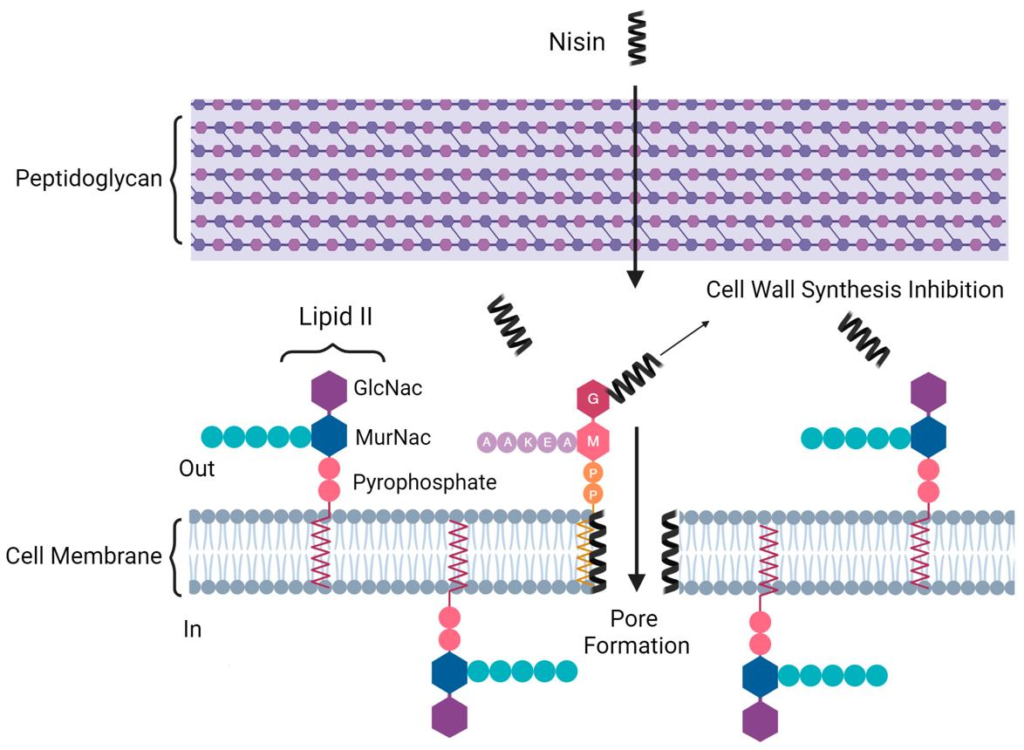
Nisin interferes with important processes in susceptible bacteria, including cell-wall formation and membrane integrity. These actions can inhibit bacterial growth and, under appropriate conditions, contribute to the control of certain bacterial spores.
Its effectiveness is influenced by the target microorganism. Nisin is generally more active against many Gram-positive bacteria than against Gram-negative bacteria, whose outer membrane can limit access to the target structures.
This distinction matters in practical food formulation. A preservative that performs well against one group of microorganisms cannot automatically replace a comprehensive preservation strategy.
Nisin should therefore be evaluated alongside the product’s microbiological risks, processing method, packaging system, storage conditions, and other preservation measures.
Key Functions of Nisin
Targeted antimicrobial activity: Nisin can inhibit susceptible bacteria, including certain organisms relevant to food spoilage and safety.
Support for preservation systems: When permitted and effective in the intended application, nisin can contribute to a broader preservation strategy.
Compatibility with selected processing conditions: Nisin can retain activity under certain acidic and heat-processing conditions, although stability depends on the complete formulation and processing profile.
Potential for formulation optimization: In suitable products, nisin may help manufacturers address specific microbiological challenges without relying exclusively on a single preservation method.
Research reviews emphasize that pH, temperature, food composition, and interactions with other ingredients can significantly affect nisin’s performance. Source: Comprehensive Reviews in Food Science and Food Safety
Major Applications of Nisin in the Food Industry
1. Processed Cheese and Cheese Spreads
Processed cheese and pasteurized cheese spreads are established application areas for nisin.
In the United States, the specific provisions in 21 CFR 184.1538 address the use of nisin preparation in certain pasteurized cheese spreads for controlling the outgrowth of Clostridium botulinum spores and toxin formation.
For manufacturers, application development should consider the cheese formulation, moisture content, pH, thermal processing, packaging, and storage conditions. Fat, proteins, and other components of the food matrix may affect how much nisin remains available to interact with target microorganisms.
A successful formulation should be validated in the actual product rather than inferred from laboratory results obtained in a simple solution.
2. Dairy-Based Food Products
Selected dairy applications may benefit from nisin’s antimicrobial properties, subject to local regulatory requirements and product-specific testing.
However, dairy products vary considerably in pH, protein composition, fat content, and mineral concentration. These differences can influence antimicrobial performance.
For example, research indicates that nisin activity can be limited in some neutral-pH dairy systems because of reduced stability and interactions with food components. Source: Journal of Dairy Science
Before commercial use, manufacturers should assess:
- Product pH and composition
- Target microorganisms and initial microbial load
- Pasteurization or other processing conditions
- Nisin addition timing and dispersion
- Refrigerated or ambient storage requirements
- Sensory quality and shelf-life performance
3. Processed and Prepared Foods
Nisin has been investigated for preservation in a range of processed foods, including selected sauces and other formulated products.
Its effectiveness varies by application. A food’s acidity, salt content, fat, protein, and physical structure can influence antimicrobial activity. The presence of Gram-negative bacteria may also limit the effectiveness of nisin as a stand-alone intervention.
Manufacturers should first identify the microorganisms of concern and determine whether nisin is permitted for the specific product category in the destination market.
Where appropriate, nisin may be evaluated as part of a combined preservation system involving validated processing, refrigeration, packaging, or other permitted hurdles.
4. Meat and Other Protein-Based Products
Research has examined nisin in selected meat and protein-based food applications. However, the suitability of nisin depends on the product, target microorganism, processing method, and applicable regulations.
Its performance in a protein-rich food cannot be predicted from results obtained in a different food matrix. Binding to food components and differences in pH or salt concentration can affect the amount of active nisin available.
For product developers, application-specific validation is essential before considering commercial implementation.
5. Food Preservation Research and Emerging Applications
Researchers continue to investigate nisin in new food systems, including combinations with other antimicrobial technologies and delivery approaches.
A 2024 study examined nisin in Mexican tomato sauce and evaluated physicochemical, sensory, and microbiological performance under different storage conditions. Such research illustrates the potential for application-specific development, but the results should not be generalized to unrelated foods or treated as a substitute for regulatory authorization. Source: International Journal of Food Science & Technology
For manufacturers, the practical lesson is straightforward: evaluate nisin against a clearly defined product challenge, using the actual formulation and intended processing conditions.

What Factors Affect Nisin Performance?
1. pH and Formulation Acidity
pH is one of the most important variables affecting nisin’s solubility, stability, and antimicrobial activity.
Nisin generally performs more favorably under acidic conditions than in many neutral-pH systems. However, the exact response depends on the food matrix and processing history.
During formulation trials, measure pH at relevant production stages rather than relying on the initial ingredient mixture alone. Changes during heating, fermentation, cooling, or storage may affect the final result.
2. Heat Treatment and Processing Time
Nisin can show useful heat stability under certain acidic conditions, but this does not mean that it remains fully active under every thermal process.
Its residual activity depends on pH, temperature, exposure time, and the composition of the food. Prolonged heat exposure under unfavorable conditions may reduce antimicrobial activity.
Manufacturers should evaluate whether nisin is added before or after a thermal processing step and determine whether the finished product retains the required level of activity.
3. Food Matrix and Ingredient Interactions
Proteins, fats, minerals, and other ingredients can affect nisin’s availability and performance.
In dairy products, for example, interactions with casein and fat globules may influence its activity. Similar formulation effects may occur in other complex foods.
When comparing formulations, evaluate nisin in the complete product rather than in water or a simplified laboratory medium alone.
4. Target Microorganisms
Nisin’s activity is not universal across all microorganisms.
Its relatively strong activity against susceptible Gram-positive bacteria does not guarantee equivalent control of Gram-negative bacteria, yeasts, or molds.
A product-specific microbiological assessment should establish the target organisms and determine whether nisin is suitable as part of the intended preservation system.
5. Addition Method and Distribution
Uneven distribution can produce inconsistent preservation performance.
The appropriate addition method depends on the commercial preparation, the food’s physical characteristics, and the production process. Manufacturers should follow the supplier’s technical guidance and evaluate dispersion, mixing time, and the sequence of ingredient addition.
Any changes to the process should be assessed through suitable microbiological and product-quality testing.
Nisin vs. Conventional Food Preservatives
Nisin and conventional chemical preservatives differ in antimicrobial spectrum, operating conditions, and permitted applications. They should not be considered interchangeable without formulation and regulatory review.
| Consideration | Nisin | Conventional preservatives |
|---|---|---|
| Antimicrobial profile | Particularly relevant to susceptible Gram-positive bacteria | Varies by preservative and target organism |
| Formulation sensitivity | Influenced by pH, food composition, and processing | Depends on the specific compound and food system |
| Application suitability | Requires product-specific evaluation | Requires product-specific evaluation |
| Regulatory conditions | Vary by market and food category | Vary by compound, market, and food category |
| Selection criteria | Target organisms, matrix compatibility, permitted use, and performance | Target organisms, matrix compatibility, permitted use, and performance |
For example, sodium benzoate and potassium sorbate are commonly associated with the control of yeasts and molds in suitable acidic foods, while nisin is primarily relevant to susceptible bacteria. Actual performance depends on the organism and food system.
The best choice is the ingredient or combination of preservation measures that meets the product’s safety, quality, regulatory, and commercial requirements.
How to Select Food Grade Nisin
Confirm the Intended Application
Start by defining the food category, target microorganisms, processing conditions, and intended shelf life.
The application determines which product specifications and regulatory documents need to be reviewed. Do not assume that a grade used successfully in one food is suitable for another.
Review Activity and Product Specifications
Nisin preparations may be characterized by antimicrobial activity, commonly expressed in international units (IU), rather than by mass alone.
When comparing suppliers, check:
- Declared nisin activity and test method
- Product composition and carrier ingredients, if applicable
- Appearance and identification
- Applicable purity and microbiological specifications
- Recommended storage conditions and shelf life
- Batch-specific Certificate of Analysis (COA)
Activity values should be compared only when the measurement methods and product basis are equivalent. A price comparison based solely on kilograms may be misleading if different preparations have different declared activities.
Verify Regulatory and Quality Documentation
Before approving a supplier, request documentation appropriate to the intended market and use.
Typical documents may include:
- Technical Data Sheet (TDS)
- Batch-specific Certificate of Analysis (COA)
- Safety Data Sheet (SDS), where applicable
- Food-grade and regulatory compliance documentation
- Product composition and carrier declarations
- Storage, handling, and shelf-life information
- Relevant quality-management certificates
In the United States, 21 CFR 184.1538 specifies identity and purity requirements and conditions for particular authorized uses of nisin preparation. In the European Union, permitted uses and maximum levels must be checked against the applicable food-additive legislation.
Documentation should be reviewed for the actual product being purchased, not simply for nisin as a general ingredient.
Bulk Nisin Sourcing: Key Considerations for Procurement Teams
Evaluate Cost Based on Functional Activity
A lower price per kilogram does not necessarily mean a lower cost of use.
For preparations with different activity levels or carrier compositions, procurement teams should compare the cost on a consistent, technically meaningful basis. The calculation should use verified supplier specifications and the actual formulation requirements.
Also consider whether the product can be incorporated consistently into the manufacturing process and whether it requires additional handling or testing.
Assess Batch Consistency
Variations in activity or product composition may affect formulation calculations and preservation performance.
Ask suppliers how they establish batch specifications, verify declared activity, manage lot traceability, and address out-of-specification results.
For critical applications, establish an incoming-material approval process and retain the documentation associated with each approved lot.
Confirm Storage and Delivery Requirements
Nisin preparations should be stored according to the supplier’s instructions. Temperature, moisture exposure, packaging integrity, and storage duration may influence product quality.
Before placing a bulk order, confirm packaging configuration, lot identification, remaining shelf life at delivery, transportation conditions, and lead time.
For international shipments, check import documentation and destination-market requirements before dispatch.
Build a Reliable Long-Term Supply Plan
A dependable supply relationship should support repeat orders, consistent specifications, timely documentation, and clear communication when product or manufacturing changes occur.
For food manufacturers, supplier qualification should consider technical support and documentation as well as price and delivery performance.
Common Mistakes When Using Nisin
Assuming it controls every microorganism: Nisin’s antimicrobial spectrum is selective, so the target organism must be identified.
Ignoring food pH: Activity and stability can change substantially across different pH conditions.
Relying on results from a simple test solution: The complete food matrix may interact with nisin and change its performance.
Overlooking thermal history: Processing temperature and exposure time can influence residual activity.
Comparing suppliers by price per kilogram alone: Declared activity, preparation composition, and specification consistency must also be considered.
Assuming regulatory approval is universal: Permitted food categories and use conditions differ between markets.
Skipping product validation: Shelf-life and microbiological claims should be supported by appropriate testing under representative production and storage conditions.
Nisin Procurement Checklist
Before approving a bulk order, confirm the following:
- The target microorganisms and intended food application are defined.
- The product is permitted for the intended use in the destination market.
- Declared activity and test methods have been reviewed.
- Formulation pH, ingredient interactions, and thermal history have been evaluated.
- The TDS, COA, and applicable regulatory documents are available.
- Storage, packaging, shelf life, and delivery conditions are confirmed.
- Product performance has been validated under representative manufacturing conditions.
- The supplier can support consistent specifications and repeat orders.
Conclusion: Choosing the Right Nisin for Food Preservation
Nisin is a targeted antimicrobial ingredient with established applications in selected food preservation systems, particularly certain processed cheese products. Its effectiveness depends on the target microorganism, formulation pH, food matrix, processing conditions, and the applicable regulatory framework.
For food manufacturers and ingredient distributors, successful sourcing requires more than identifying a suitable preservative. Activity specifications, batch consistency, documentation, and application-specific validation all contribute to a reliable procurement decision.
Sunway supports B2B customers sourcing food ingredients for industrial applications. To discuss your ingredient requirements, technical documentation, or bulk sourcing needs, visit https://sunwayadditive.com/.
Frequently Asked Questions
1. What is nisin used for in food?
Nisin is an antimicrobial peptide used in selected food preservation applications. Its suitability depends on the target microorganisms, food formulation, processing conditions, and applicable regulations.
2. Is nisin the same as E234?
E234 is the food additive number for nisin in the European Union. Buyers should verify the permitted uses and conditions that apply to their specific food category and destination market.
3. Does nisin work against all bacteria?
No. Nisin is particularly active against susceptible Gram-positive bacteria, but it does not provide universal control of all bacteria, yeasts, or molds.
4. Does pH affect nisin activity?
Yes. Nisin’s solubility, stability, and antimicrobial activity are influenced by pH, with performance generally more favorable under acidic conditions than in many neutral-pH systems.
5. What should buyers check when sourcing nisin in bulk?
Buyers should review declared activity, product composition, batch specifications, regulatory documentation, storage requirements, shelf life, and supplier consistency before approving a bulk order.