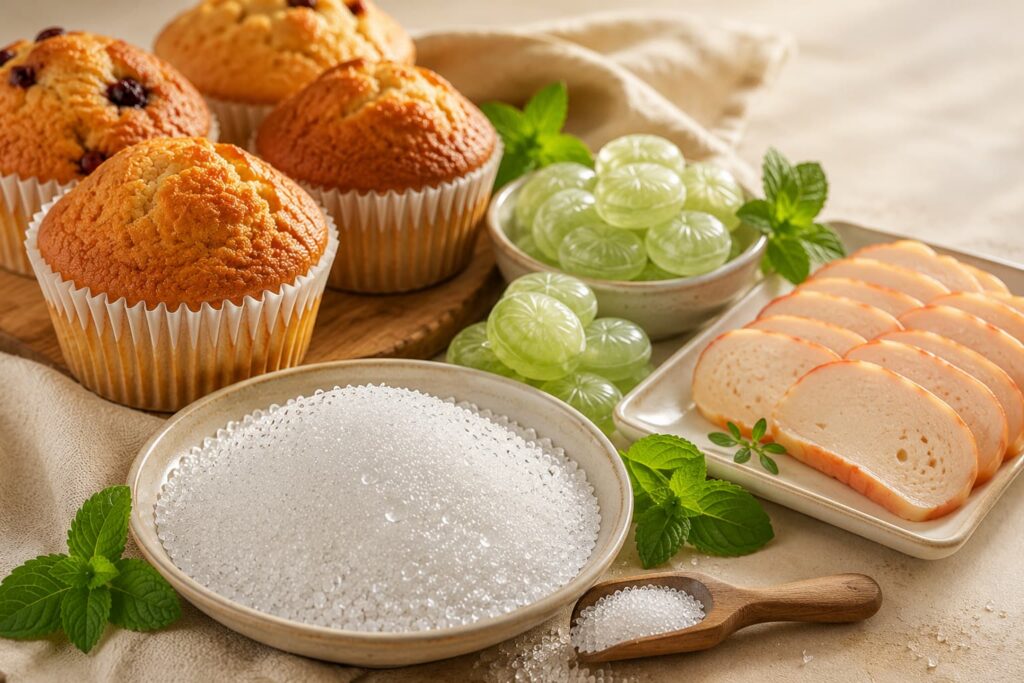
Sorbitol powder has been a staple functional ingredient in global food manufacturing for decades. While widely recognized as a bulk sugar substitute, its technical value extends far beyond mere sweetness. For food formulators and procurement directors, sorbitol is a critical multi-functional tool used to control moisture, preserve protein structures, and modify texture. However, sourcing and formulating with sorbitol powder involves distinct industrial challenges—ranging from severe caking during maritime transit to product stickiness under tropical storage conditions. This guide provides food manufacturers with a comprehensive technical evaluation of sorbitol powder, its core applications, and a strategic checklist for bulk procurement.
Technical Overview: What Is Sorbitol Powder?
Sorbitol also classified as a hexahydric sugar alcohol or polyol, occurs naturally in various fruits but is commercially produced via the catalytic hydrogenation of glucose derived from cornstarch. In bulk food manufacturing, sorbitol is utilized in two primary forms: liquid syrup and crystalline powder. Crystalline sorbitol powder appears as a white, odorless, hygroscopic crystalline solid. It delivers approximately 60% of the sweetness of sucrose at a reduced caloric value of 2.6 kcal/g. Chemically, it possesses a high negative heat of solution of -110.9 J/g, which produces a distinct mouth-cooling sensation. Furthermore, its excellent thermal and pH stability ensures it can withstand high-temperature processing without undergoing Maillard browning or fermenting with yeast and bacteria.
Core Functional Roles in Industrial Food Systems
Sorbitol powder behaves as a hard-working, multi-tasking additive in large-scale food processing plants. Its chemical structure contains six hydroxyl groups, allowing it to form strong hydrogen bonds with water molecules. This intense humectancy lowers the water activity of food systems, binding free water to prevent baked goods from drying out while simultaneously inhibiting microbial proliferation to extend shelf life. In sugar-free confectionery, sorbitol powder provides the necessary bulk and body without altering the desired mouthfeel, acting as a powerful crystallization inhibitor that prevents other sugars or polyols from forming large, gritty crystals. In frozen seafood and surimi processing, sorbitol powder serves as an industry-standard cryoprotectant, penetrating muscle proteins to prevent their denaturation and aggregation during deep-freezing, which preserves the elasticity and water-holding capacity of the seafood upon thawing.
Top Industrial Applications & Formulation Strategies
In sugar-free confectionery and chewing gum, sorbitol is the premier choice due to its refreshing cooling burst. However, because sorbitol absorbs moisture rapidly, ambient humidity in the blending and packaging rooms must be strictly controlled below 40% RH to prevent the compound from turning sticky during manufacturing. In industrial bakery products like cakes and soft cookies, sorbitol powder maintains crumb softness over extended distribution cycles by slowing down starch retrogradation. Since sorbitol does not undergo the Maillard reaction, formulators aiming for a golden-brown crust must carefully blend it with a reducing sugar or a protein source to achieve the targeted appearance. For surimi processing, sorbitol powder is typically blended with sucrose or polyphosphates into raw fish paste prior to freezing, ensuring structural integrity and preventing moisture purge during long-term cold chain logistics.
Technical Troubleshooting: Overcoming Formulation Hurdles
While highly functional, sorbitol’s intense affinity for water can complicate production lines if not managed properly. Food formulators frequently complain that soft candies or baked goods containing sorbitol become overly sticky or “sweat” when shipped to hot, humid markets.
📌 From our supplier experience: A confectionery manufacturer in Southeast Asia faced massive retail returns because their sugar-free compressed mints became sticky and degraded inside the plastic dispensers within two weeks of delivery. The client initially blamed the purity of the sorbitol. Our R&D laboratory analyzed their production parameters and discovered that the client was using 100% sorbitol powder in a high-humidity manufacturing plant without environmental controls. To resolve the issue, Sunway’s technical team formulated a synergistic blend, replacing 25% of the sorbitol with Maltitol—which has lower hygroscopicity—and introducing a precise 0.5% fraction of Xanthan Gum to stabilize the free moisture. The mints maintained their clean cooling profile while completely eliminating the sweating issue, even under tropical conditions.
The Bulk Sourcing Checklist for Procurement Directors
Sourcing bulk sorbitol powder requires a deep understanding of physical logistics and mechanical manufacturing requirements to prevent operational disruptions. Particle size is paramount; direct compression tableting mandates a coarse, granulated sorbitol of 40-60 mesh with excellent flowability to fill tablet dies uniformly, whereas fine blending requires an 80-100 mesh powder for rapid dissolution. Furthermore, because sorbitol powder is highly hygroscopic, maritime shipping across equatorial routes exposes bulk containers to intense temperature fluctuations, leading to container sweat that can cause standard paper packaging to absorb moisture and turn the powder into solid blocks.
📌 From our supplier experience: A major distributor in Latin America reported that a 20-foot container of sorbitol powder sourced from a generic trading company arrived as a single, hardened mass of rock, forcing workers to manually smash the bags open and causing severe clogs in their pneumatic feeding system. When the client transitioned to Sunway, we deployed our standard Anti-Caking Logistics Protocol. We utilize an automated crystallization-drying process at our invested factories to guarantee a baseline moisture content of less than 1.0%. Every bulk order is packed in heavy-duty, reinforced double-layer PE inner bags that are heat-sealed and enclosed in a moisture-barrier multi-ply kraft paper bag. Finally, we line the shipping containers with heavy-weight desiccants and moisture-absorbent blankets to stabilize ambient humidity during ocean transit, maintaining a 100% cake-free arrival record for overseas shipments.

Essential Compliance & Regulatory Standards
Procurement directors must never compromise on international food safety standards when evaluating a sorbitol powder supplier. A qualified partner must provide valid FSSC 22000 or ISO 22000, US FDA Registration, HALAL, and KOSHER certifications, alongside a batch-specific Certificate of Analysis verifying an assay purity of 99.0% or higher, total sugars below 0.3%, nickel residue under 1 mg/kg, and strict microbiological clearances for Salmonella and E. coli. Buyers should also note that while sorbitol has a stable shelf life of 24 months when stored unopened below 25°C and 60% RH, excessive consumption can cause a laxative effect, meaning that finished foods containing high concentrations must often include a mandatory warning label in major jurisdictions.
Final Thoughts
Sorbitol powder remains an indispensable, high-efficiency asset for modern food manufacturing, provided you understand its physical limitations around moisture and choose the appropriate grade for your machinery. Mitigating formulation stickiness and logistics caking requires a supplier that offers advanced technical engineering alongside raw chemical supply. At Sunway, we leverage our 5 invested manufacturing sites, 2 specialized laboratories, and 30 senior food technicians to deliver tailor-made formulations and ironclad supply chain stability. If you are looking to optimize your sugar-free formulation or require a custom mesh size, please contact our technical sales engineering desk at Saleskaren@jysunway.com to request free samples, technical datasheets, or a competitive bulk quotation today.